Now, I'll come clean and admit that my stance has always been that these animals are worth saving in their own right.
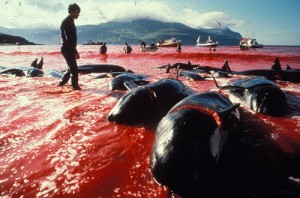
(Picture credit: Green Living Earth)
There's no good reason to hunt these creatures, and I won't even get into the specious arguments some nations use about "scientific" whaling, which is a thin disguise for commercial hunting. More than enough good science can be done with live animals in their natural environment than has ever been achieved by killing them.
But I acknowledge that such thinking cuts little ice with the decision-makers in this world.
What most delighted me about this article was that this research should appeal to some influential folks. Big business cares nothing of the lives and well-being of ordinary citizens, but it does care about the bottom line. And that's where it gets interesting...
The established view in the fishing industry goes as follows: There is a food chain. Those at the bottom get eaten by those at the top. Therefore, fewer predators at the top means more survive lower down.
So, creatures like whales and squid are seen as a bad thing, because they (literally) eat into the profits of fishermen.
But this is only part of the picture.
The marine ecosystem is not a one-way street; it is a cycle.
The top predators don't just take from the system. They are, in fact crucial to the health of the whole ecosystem.
The middle links in the food chain depend on the microscopic organisms at the bottom, particularly photosynthetic plankton. The entire system is limited by the productivity of these foundational species. And they, in turn, are limited by the nutrients available in the sunlit layers of the ocean.
Here's the catch. Nutrients tend to sink rapidly into the depths, where they cannot be used for photosynthesis.
It turns out that large animals are vital in re-circulating "lost" nutrients back into the upper layers.
Before efficient whaling removed the majority of the population of whales, the world's oceans were teeming with life. Today's oceans are barren wastelands compared to what they were only a few hundred years ago.
If the "top predators" dogma were true, fish should be even more abundant now, but they aren't. By removing large animals, we have made the oceans a much poorer place.
These predators give way more back than they take out.
If the fishing industry, the same industry that has so successfully resisted any attempts to limit catches to sustainable levels, realizes that more whales = more fish, then that gives me hope.
Sadly, the world is ruled by self-interest.
For once, self-interest may be a good thing.




 Posts
Posts


